


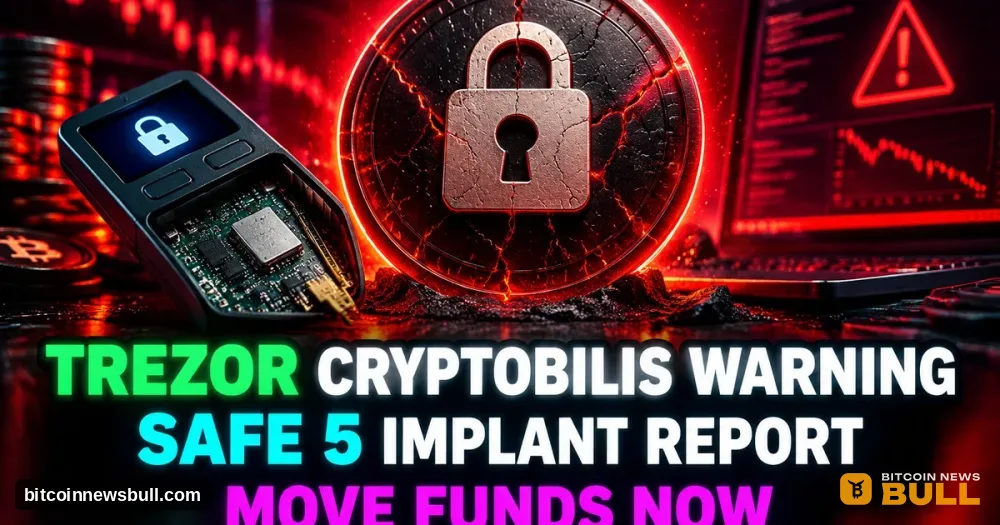
On October 30, 2026, Trezor issued a warning urging customers to transfer their assets away from any wallets purchased from the reseller CryptoBilis since March. The advisory followed an Indonesian buyer’s report of a potential cellular implant inside a Trezor Safe 5.
Trezor received the notification on October 28. The customer had acquired the device via Tokopedia in August and submitted the information through Trezor’s responsible disclosure program. Decrypt noted that the manufacturer considers the report credible, even though the hardware has not yet arrived at its lab.
Inside the Reported Safe 5 Implant
According to the description, the modification consists of an extra circuit board positioned between the primary board and the display, equipped with a cellular module and an antenna.
Read More: Ledger vs Trezor: Which Hardware Wallet Is Better?
Although a laboratory examination is not yet complete, Trezor possesses photographs and a video interview with the customer. The company decided to make the information public immediately to prevent further exposure for other CryptoBilis customers.
CryptoPotato reported that the unauthorized hardware component could capture whatever appeared on the screen—including wallet backups—and transmit the data over a mobile network whenever the wallet was plugged in.
CryptoBilis update
We've been made aware, through responsible disclosure, of a single hardware implant in a Trezor Safe 5 device bought from the reseller CryptoBilis in August 2026.
No CryptoBilis buyer has reported a loss of funds to us.
IMPORTANT: If you bought a Trezor from… pic.twitter.com/TiaKfHBnX2
— Trezor (@Trezor) October 30, 2026
Trezor CryptoBilis warning: Affected Buyers Must Create a New Wallet and Move Their Funds
Any individual who bought a device from CryptoBilis from March 2026 onward should transfer their funds immediately to a wallet created with a newly generated recovery phrase. Reusing the potentially compromised phrase on a different hardware wallet will not resolve the issue.
Uninitialized devices bought from CryptoBilis should remain untouched; users must avoid setting them up or typing existing backups into them. Trezor advises that if a secure hardware wallet is unavailable, a software wallet or a trusted exchange can serve as a temporary solution, provided the full receiving address is carefully verified prior to sending.
The Indonesian customer had already transferred their assets. Trezor stated that no other buyers from CryptoBilis have reported any financial losses.
Trezor Removed CryptoBilis and Offers Replacements
Following Ledger’s investigation into losses connected to the Southeast Asian distributor, Trezor removed CryptoBilis from its authorized reseller list on October 9. Since then, four units from the vendor have been inspected—consisting of a Safe 7, two Safe 5s, and a Safe 3—and all showed no signs of tampering.
The Indonesian Safe 5 was not part of that group of four. Trezor pointed out that the suspicious element resembles an implant previously found in a Ledger device, though the origin of the modification remains unknown.
Customers can retain their CryptoBilis hardware and reach out to Trezor Support to receive either a direct replacement shipped from the company or a voucher for a new device.
Users must also remain vigilant against phishing attempts. Fraudulent emails, letters, and phone calls may attempt to steal recovery phrases or direct individuals to fake replacement procedures.
Cointelegraph reported that the manufacturer is currently evaluating its hardware security measures, acknowledging that packaging and seals alone cannot guarantee a device has not been intercepted before reaching the end user.
FAQ
When did Trezor issue the warning?
The warning went out on October 30, 2026. The disclosure behind it reached Trezor on October 28, from a buyer in Indonesia.
Which CryptoBilis purchases are covered by the warning?
Wallets bought from CryptoBilis from March 2026 onward. The buyer who raised the alarm picked up a Safe 5 through Tokopedia in August 2026.
What did Trezor find when it inspected other CryptoBilis devices?
Four units — a Safe 7, two Safe 5s and a Safe 3 — came apart clean, with no tampering. The Safe 5 from the Indonesian report is a separate case.
What replacement support is Trezor offering affected buyers?
Keep the device if you like, and contact Trezor Support. Trezor said it will ship a replacement directly or hand over a voucher for a new device.
What information could the reported implant capture?
By the customer’s account, the component could read the Safe 5 screen, wallet backup included, then send it over a cellular network while the wallet was connected to power.
This article is for information only and is not financial advice.